


Website ·
English · 繁體中文
**Tiny engine, immense model.** Run **GLM-5.2 (744B-parameter MoE)** on a consumer machine with ~25 GB of RAM — in pure C, with zero dependencies, by streaming experts from disk.
Colibrì is a lightweight, quality-preserving MoE runtime that treats VRAM, RAM,
and storage as one managed memory hierarchy. Insufficient fast memory may reduce
speed, but the default policy **never silently changes model precision or router
semantics**.
```
$ ./coli chat
🐦 colibrì v1.0 — GLM-5.2 · 744B MoE · int4 · streaming CPU
✓ ready in 32s · resident 9.9 GB
› ciao!
◆ Ciao! 😊 Come posso aiutarti oggi?
```
## See it running
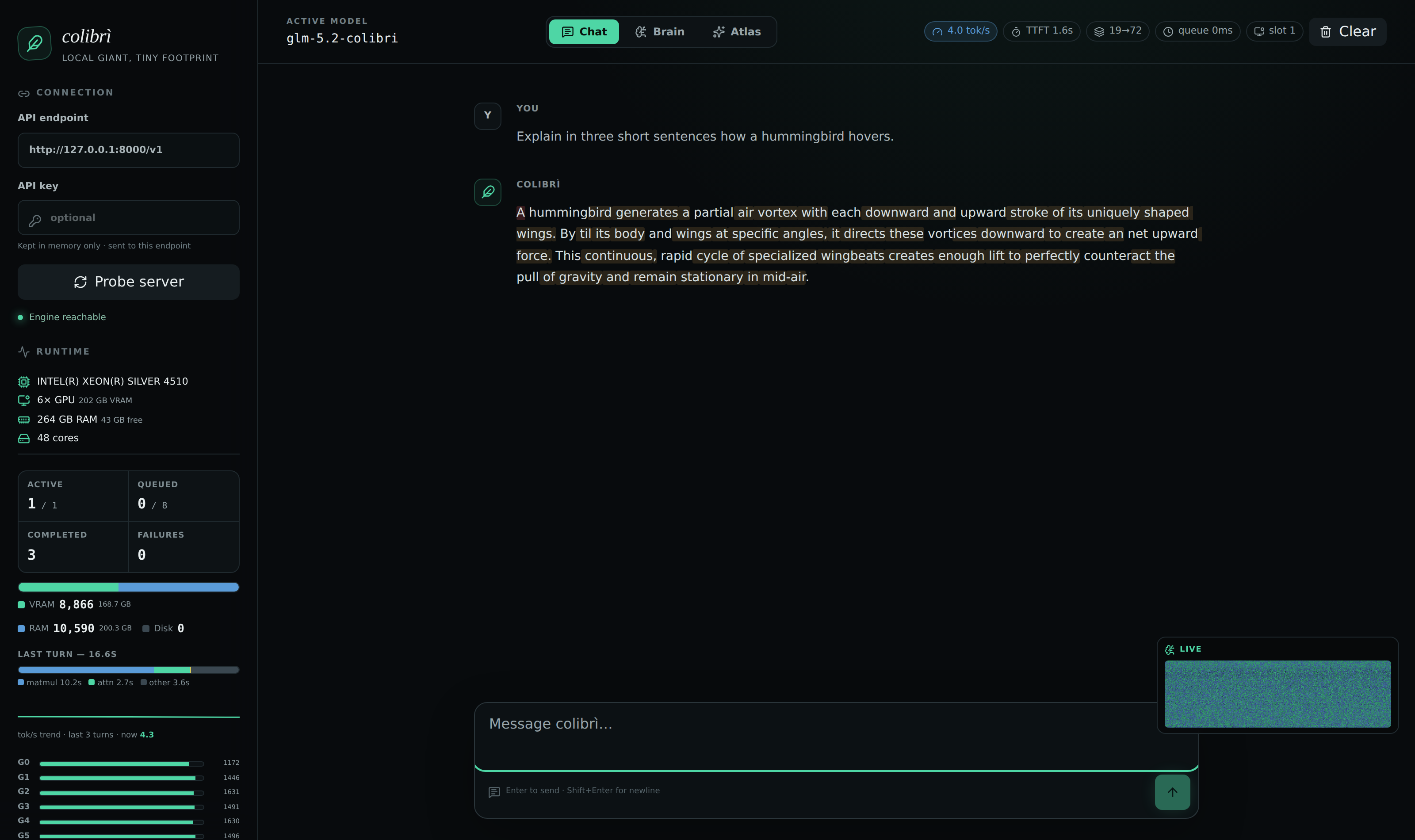
The web dashboard (./coli web): a 744B model at 4 tok/s, TTFT 1.6 s, disk 0 —
full expert residency on 6× RTX 5090, with live token metrics, the per-turn time breakdown,
the VRAM/RAM/disk tier bar and the live mini-brain in the corner.
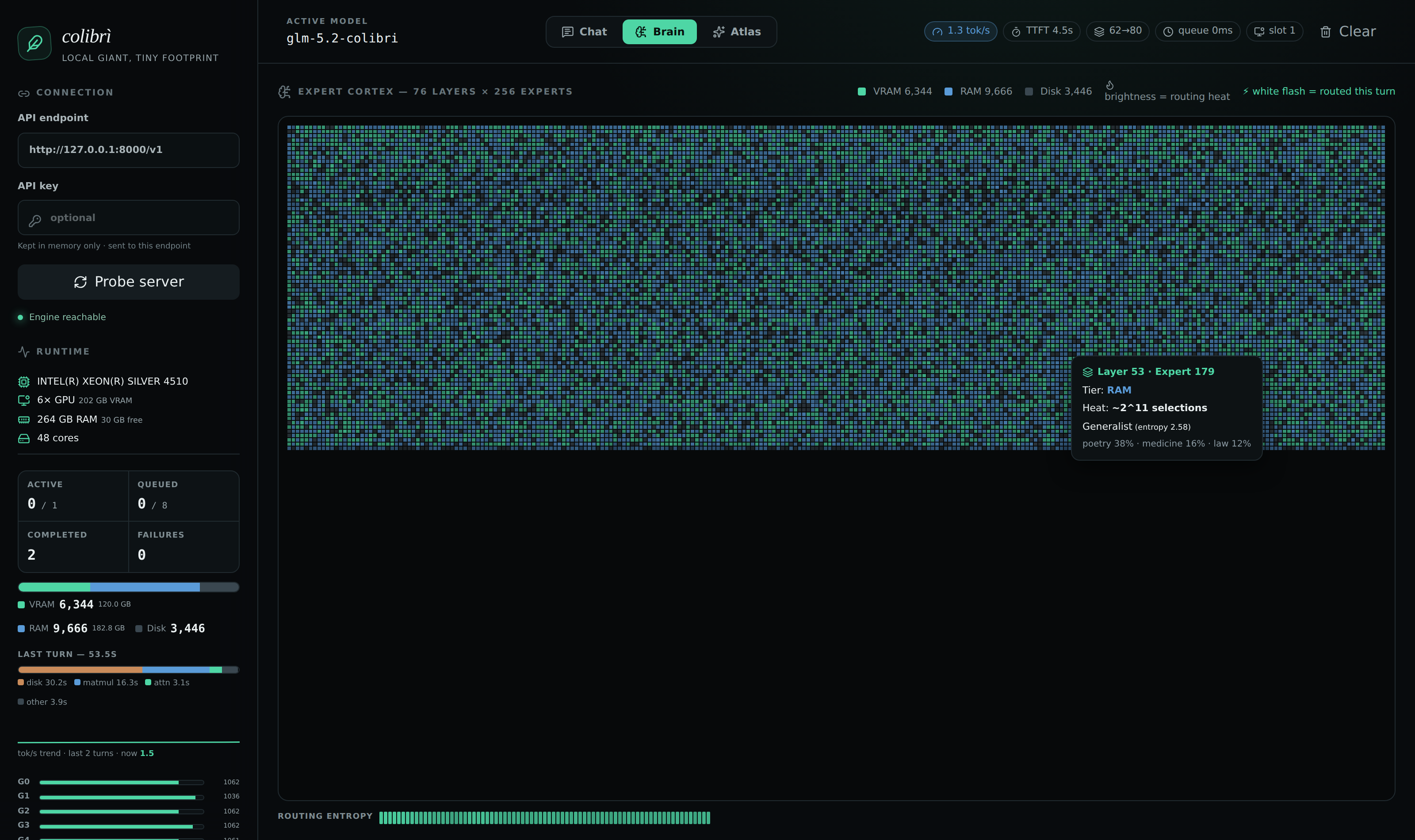
The Brain page: all 19,456 experts as a living cortex — colour is the storage tier,
brightness is routing heat, and every expert routed in a turn flashes white. Hovering shows the expert's
measured topic affinity.
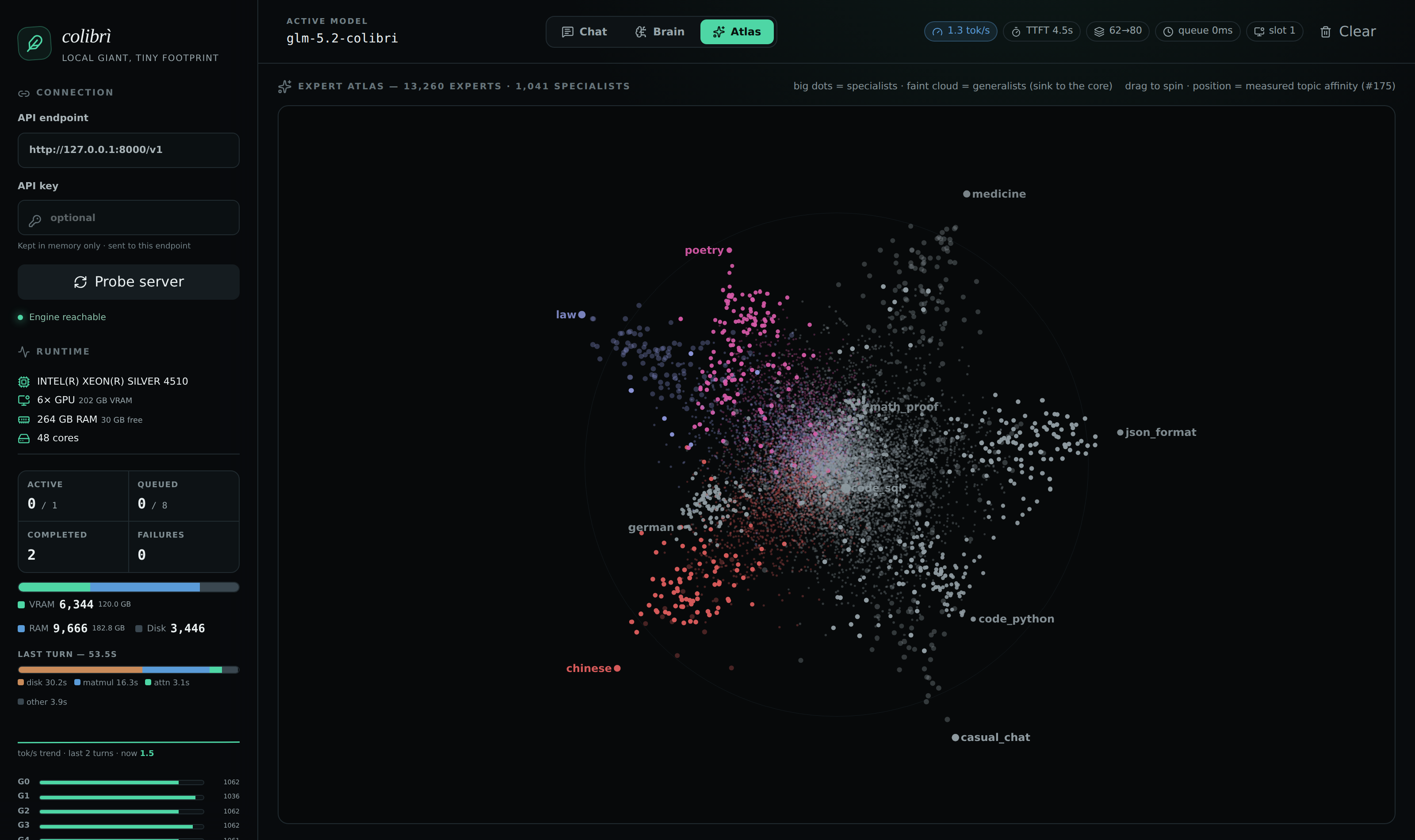
The Atlas page: the measured expert atlas
as a 3-D galaxy — 13,260 characterised experts, 1,041 replicated specialists clustering by topic
(poetry, law, Chinese, SQL…). Position is measured routing affinity, not a learned embedding. Drag to spin.
## The idea
A 744B Mixture-of-Experts model activates only ~40B parameters per token — and
only ~11 GB of those change from token to token (the routed experts):
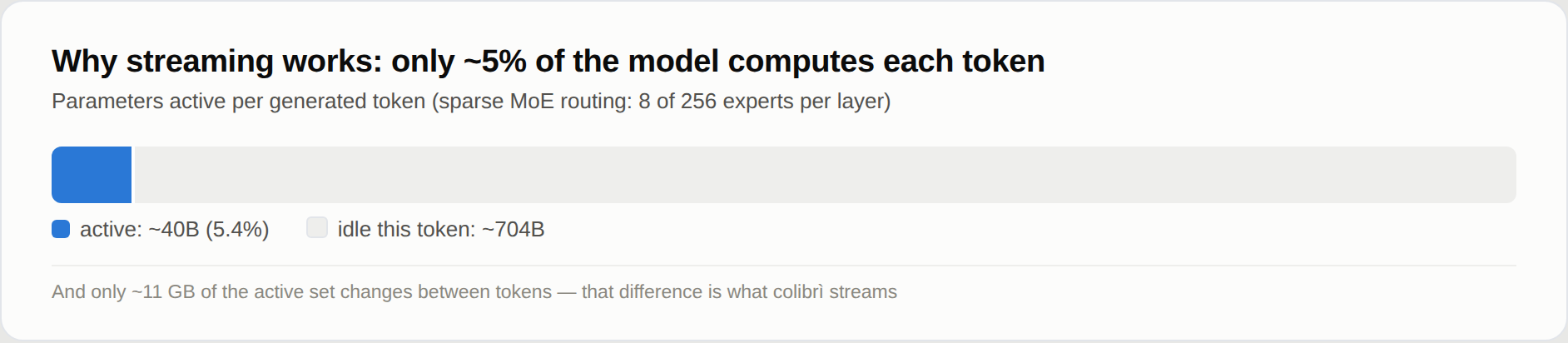
So the model doesn't need to *fit* in fast memory — it needs to be **placed**:
- the **dense part** (attention, shared experts, embeddings — ~17B params) stays
**resident in RAM at int4** (~9.9 GB);
- the **19,456 routed experts** (75 MoE layers × 256 + the MTP head, ~19 MB each
at int4) live **on disk** (~370 GB) and are **streamed on demand**, with a
per-layer LRU cache, a learned pinned hot-store, and an optional VRAM tier.
The engine is a single C file (`c/glm.c`) plus small headers. No BLAS, no Python
at runtime, no GPU required.
## How it works
### The per-token path
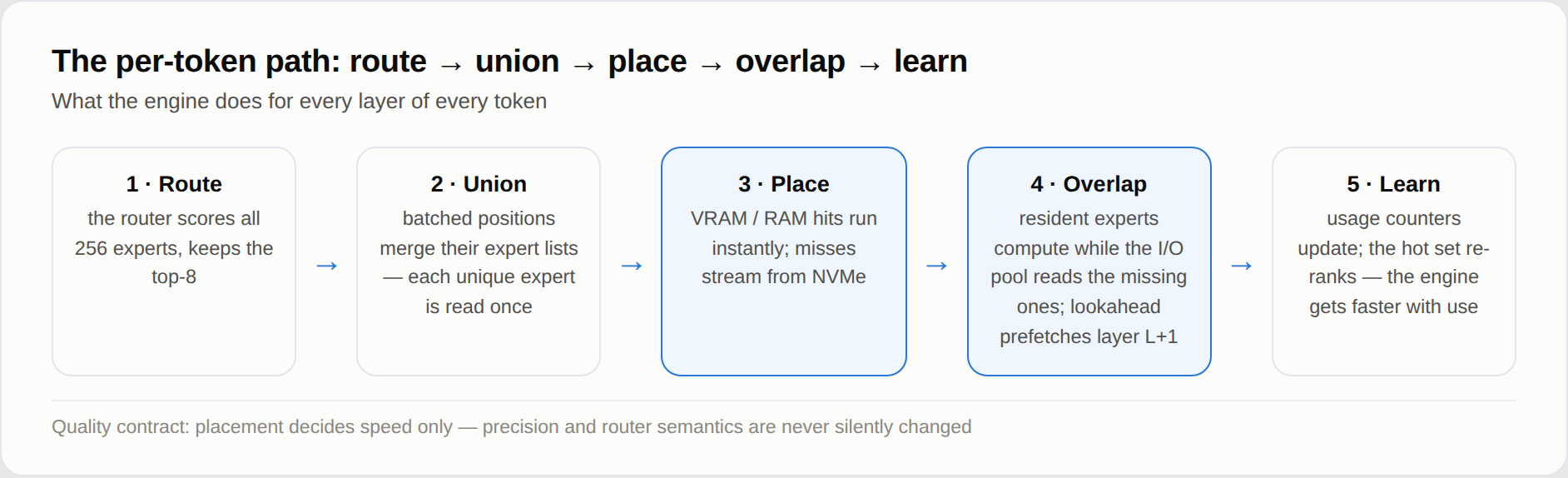
Every layer of every token walks the same five steps. The design goal is that
**placement only ever decides speed** — the router's decisions and the weights'
precision are the same whether an expert answered from VRAM or from disk.
### One memory hierarchy instead of one memory requirement
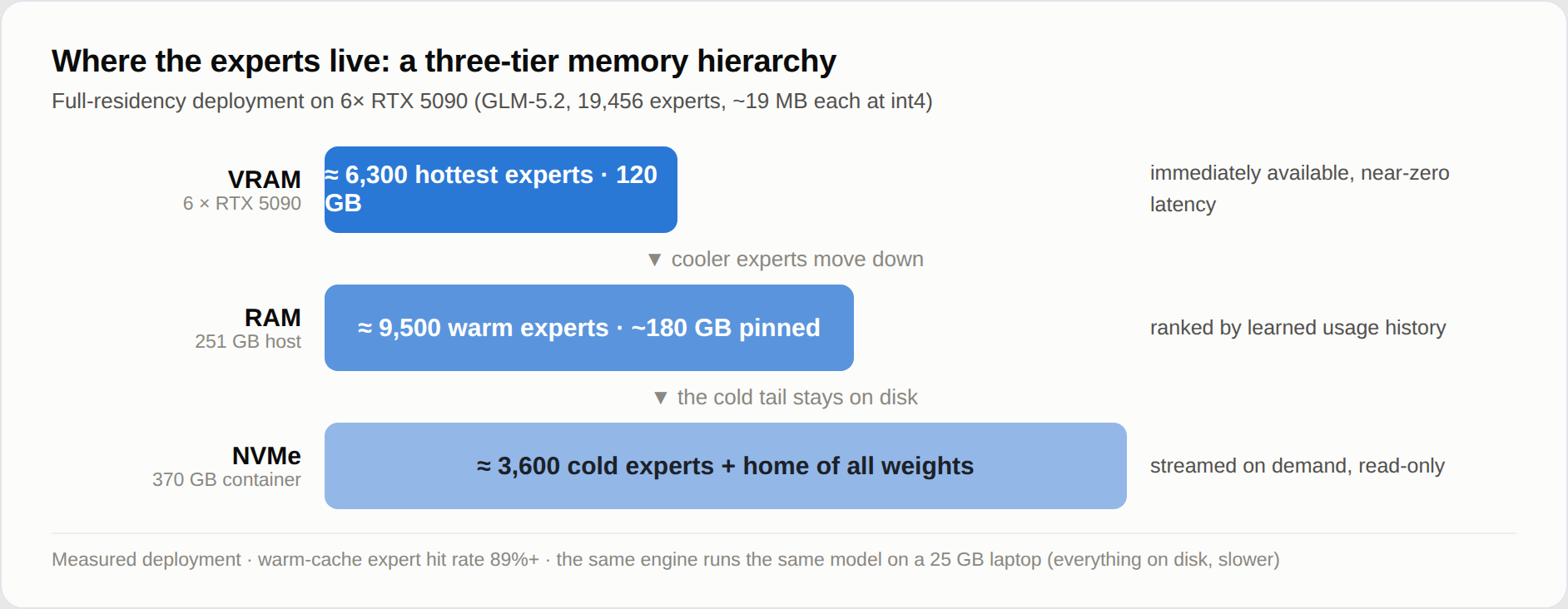
The same engine spans the whole range: on a 25 GB laptop everything streams from
disk (slow but correct); on a large host the entire expert set becomes resident
(`CUDA_EXPERT_GB=auto PIN_GB=all`) and disk drops out of the decode path
entirely. Between the tiers sits a **learning cache**: the engine records which
experts *your* workload routes to (`.coli_usage`, updated every turn) and pins
the hottest ones automatically — colibrì literally gets faster the more you use
it. On multi-socket hosts, `COLI_NUMA=1` interleaves the resident weights across
memory controllers ([#82](https://github.com/JustVugg/colibri/issues/82)).
### Never wait for the disk twice
Misses are expensive, so the engine spends most of its cleverness avoiding and
overlapping them: each expert's three matrices are stored adjacent and read in
one `pread`; a bounded async I/O pool (`PIPE=1`, default) loads missing experts
while resident ones compute; batched positions read each unique expert once
(**batch-union**); and a router-lookahead thread (`PILOT=1`) prefetches the next
layer's experts — routing is measurably **71.6% predictable one layer ahead**.
On GPUs, the resident pipeline (`COLI_CUDA_PIPE=2`) keeps the residual stream
on-device across layers so the CPU expert loop runs uninterrupted; on Apple
Silicon an experimental [Metal backend](docs/metal.md) does the batched expert
math on the unified-memory GPU.
### Faithful model, compressed state
The forward pass is validated **token-exact against a `transformers` oracle**
(teacher-forcing 32/32). MLA attention stores a compressed KV state — 576
floats/token instead of 32,768 (**57× smaller**) — and persists it across
restarts (`.coli_kv`): conversations reopen warm with zero re-prefill,
byte-identical to an uninterrupted session. DSA sparse attention (GLM-5.2's
lightning indexer) is implemented faithfully and validated by forcing full-key
selection to reproduce dense attention exactly.
### Speculative decoding, honestly
GLM-5.2's native MTP head drafts tokens that the main model verifies in one
batched forward — 2.2–2.8 tokens/forward when it pays. Two hard-won rules ship
as defaults: the MTP head must be **int8** (int4 heads collapse to 0–4%
acceptance, [#8](https://github.com/JustVugg/colibri/issues/8)), and draft and
verify must compute **the same function** — `SPEC_PIN=1` pins both to one
kernel family ([#163](https://github.com/JustVugg/colibri/issues/163) is the
full forensic story). Grammar-forced drafts
([`GRAMMAR=file.gbnf`](docs/grammar-draft.md)) add ~free acceptance on
constrained JSON output. Whether speculation is a net win depends on your
cache temperature — measure, and use `DRAFT=0` when it doesn't pay.
## What it achieves
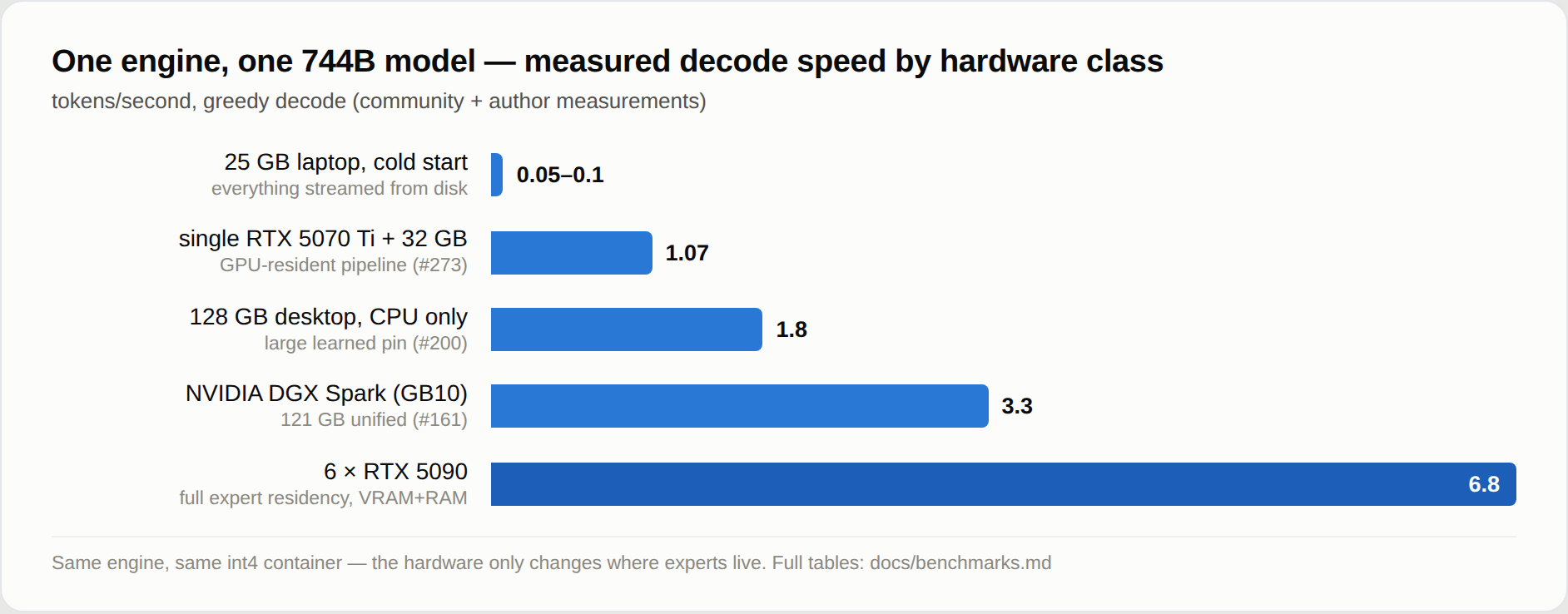
Same engine, same int4 container — the hardware only changes where the experts
live. Highlights from the [full benchmark tables](docs/benchmarks.md):
- **6× RTX 5090, full residency:** 5.8–6.8 tok/s decode, TTFT ~13 s
([experiment log](docs/experiments/glm52-6x5090-2026-07-12.md));
- **128 GB CPU-only desktop:** ~1.8 tok/s warm ([#200](https://github.com/JustVugg/colibri/issues/200));
- **single RTX 5070 Ti laptop-class box:** 1.07 tok/s via the GPU-resident
pipeline ([#273](https://github.com/JustVugg/colibri/issues/273));
- **25 GB dev box:** 0.05–0.1 tok/s cold — the proven floor where this project
started, and still the honest baseline.
Quality is measured, not assumed: the int4 container's quantization cost and the
scale-granularity/rotation ablations live in
[docs/benchmarks.md](docs/benchmarks.md#quality-benchmark) and
[#108](https://github.com/JustVugg/colibri/issues/108)/[#81](https://github.com/JustVugg/colibri/issues/81).
## Get started
> **New here, or on Windows?** The [Quick Start guide](docs/quickstart.md) walks
> through install → build → model → first chat step by step for Linux, Windows,
> and macOS. On **Windows** you don't even need to build: download the
> `colibri--windows-x86_64.zip` from
> [Releases](https://github.com/JustVugg/colibri/releases), unzip it, rename
> `colibri-*-windows-x86_64.exe` → `glm.exe`, install
> [Python 3](https://www.python.org/downloads/), and run `coli chat` — full
> details in the [Windows section](docs/quickstart.md#windows).
### 1. Get the model
A pre-converted **GLM-5.2 int4** container is on Hugging Face — **use the
version with the int8 MTP heads**:
**https://huggingface.co/mateogrgic/GLM-5.2-colibri-int4-with-int8-mtp**
> ⚠️ The original mirror ships int4 MTP heads → 0% draft acceptance
> ([#8](https://github.com/JustVugg/colibri/issues/8)). Check yours:
> `ls -l /out-mtp-*` — int8 (correct) is `3527131672 / 5366238584 / 1065950496`.
Or convert from the FP8 source yourself — one resumable command that never needs
the full 756 GB on disk at once:
```bash
cd c && ./setup.sh # checks gcc/OpenMP, builds, self-tests
./coli convert --model /nvme/glm52_i4 # download+convert shard by shard (python, one-time)
```
### 2. Run it
```bash
COLI_MODEL=/nvme/glm52_i4 ./coli chat # RAM budget, cache and MTP auto-detected
COLI_MODEL=/nvme/glm52_i4 ./coli plan # inspect the planned VRAM/RAM/disk placement
COLI_MODEL=/nvme/glm52_i4 ./coli doctor # read-only readiness check
./coli web --model /nvme/glm52_i4 # API + web dashboard on one port
./coli serve --model /nvme/glm52_i4 # OpenAI-compatible API only
```
The engine at runtime is pure C — python is only used by the one-time converter
and the optional API gateway.
### 3. Go deeper
| topic | doc |
|---|---|
| Benchmarks, community datapoints, quality measurements | [docs/benchmarks.md](docs/benchmarks.md) |
| Tuning knobs, policies, the learning cache, prefetch | [docs/tuning.md](docs/tuning.md) |
| Windows 11 native build (+ CUDA DLL) | [docs/windows.md](docs/windows.md) |
| CUDA backend, VRAM expert tier, full residency | [docs/cuda.md](docs/cuda.md) |
| Apple Silicon Metal backend | [docs/metal.md](docs/metal.md) |
| OpenAI-compatible API, KV slots, web dashboard | [docs/api.md](docs/api.md) |
| Grammar-forced drafts (structured output) | [docs/grammar-draft.md](docs/grammar-draft.md) |
| Environment variable inventory | [docs/ENVIRONMENT.md](docs/ENVIRONMENT.md) |
## Supporting the project
colibrì started as a one-person project on a 12-core laptop with 25 GB of RAM;
today its numbers come from a community of real machines. If it's useful to you:
- ⭐ star the repo and share it;
- 🐛 open issues with benchmark numbers from your hardware — datapoints move
this project more than anything else;
- 💬 reach out via GitHub issues to sponsor development or donate hardware.
## Repo layout
```
Makefile root build/check entry point
c/
├── glm.c single-file GLM engine
├── st.h, tok.h, json.h runtime headers
├── backend_cuda.* optional CUDA tier
├── Makefile build and local checks
├── coli user-facing CLI
├── openai_server.py OpenAI-compatible HTTP gateway
├── setup.sh one-command local setup
├── tools/ offline conversion, fixtures and benchmarks
├── scripts/ long-running conversion helpers
└── tests/ dependency-free C and Python tests
web/ browser UI (pure OpenAI-API client)
desktop/ Tauri v2 desktop shell wrapping the web UI
docs/ reference docs, experiments, media
```
The runtime path intentionally stays flat and readable: `glm.c` plus its small
headers. From the repository root, `make`, `make check`, and `make clean`
delegate to the engine Makefile.
## Why "colibrì"
The hummingbird weighs a few grams, hovers in place, and visits a thousand
flowers a day. This engine keeps a 744-billion-parameter giant alive on
hummingbird rations: 25 GB of RAM, twelve CPU cores, and a lot of disk patience.
## License
Apache 2.0. GLM-5.2 weights are released by Z.ai under MIT.